Adenostemma viscosum
Dublin Core
Title
Adenostemma viscosum
Subject
Taxonomy
Phylum :Tracheophyta
Class :Magnoliopsida
Order :Asterales
Family :Asteraceae
Genus :Adenostemma
Species :Adenostemma viscosum
Phylum :Tracheophyta
Class :Magnoliopsida
Order :Asterales
Family :Asteraceae
Genus :Adenostemma
Species :Adenostemma viscosum
Synonyms
Adenostemma dregei DC., Adenostemma glutinosum DC., Adenostemma macrophyllum (Blume) DC., Adenostemma microcephalum DC., Adenostemma natalense DC., Adenostemma ovatum Miq., Adenostemma parviflorum (Blume) DC., Adenostemma perrottetii DC., Ageratum strictum Sims, Ethulia aquatica Roxb. ex DC., Lavenia glutinosa Gaudich., Lavenia macrophylla Blume, Lavenia parviflora Blume, Lavenia viscida Buch.-Ham.
Common name
Rumput tahi babi, Daun susu babi, Rumput pasir, Dung weed
Description
Characteristics
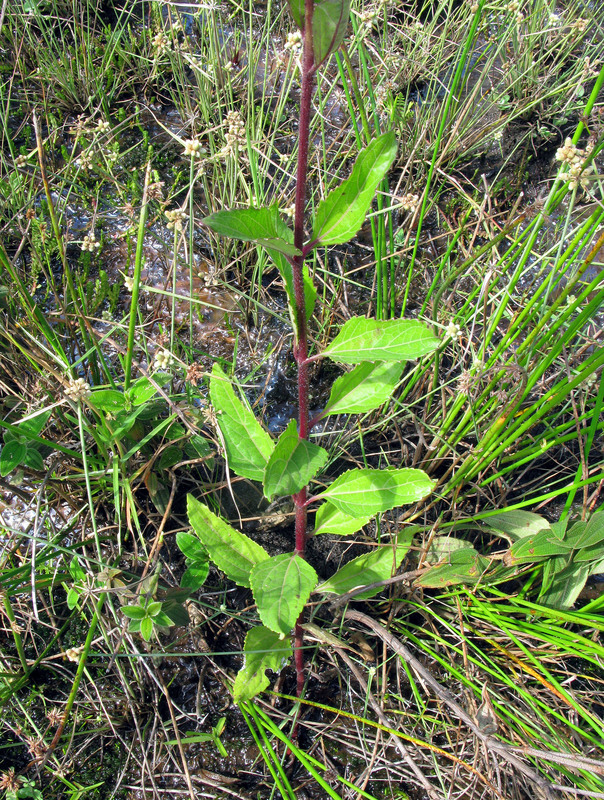
An annual or sometimes perennial herb that can reach a height of between 30-100 cm and often rooting at the lower nodes.
An annual or sometimes perennial herb that can reach a height of between 30-100 cm and often rooting at the lower nodes.
Morphology
Leaves
Simple where the lower leaves are opposite while the upper ones are alternate. The leaves form is broad elliptical to oblong and broadly egg-shaped and measure about 4-20 cm x 3-12 cm. The leaves base is rounded-cuneate, the apex is acute to obtuse and margins are dentate to serrate. The leaf stalk size of the lower leaves is up to 9 cm long while the upper leaves are almost stalkless. There are no stipules.
Inflorescence
Consisting of heads in a lax terminal paniculate corymb. The inflorescence stalk measures 1-4 cm long. The ring of its bracts is shaped like a bell or cup-shaped, it has 2-seriate, scales sub-equal, herbaceous, and more or less connate at the base. The glandular head is measures about 3-7 mm x 6-10 mm that about 30-flowered. The flowers are all tubular with petals about 1.5-2 mm long and divided into 4, on the outside with glandular hairs in white or violet. It has 5 stamens with the ovary at the inferior of it style bifid- its branches are slender and long, thickened at the top.
Fruit
Small, obovate-oblong in shape, irregularly triangular with measures about 2.5-4 mm x 1 mm. It is glandular when young but afterwards smooth or warty and crowned with a pappus consisting of a few clavate setae which usually thickened at the top and glandular. The seedling is with epigeal germination.
Chemical compound
11-Hydroxylated kauranic acids, viz, ent-11α-hydroxy-15 α -acetoxykaur-16-en-19-oic acid, ent-11α, 15 α -dihydroxykaur-16-en-19-oic acid, (l6R)-ent-11α -hydroxy-15-oxokauran-19-oic acid and ent-11α -hydroxy-15-oxokaur-16-en-10-oic acid and their glycosides.
Plant part used
Whole plant, leaves and roots.
Traditional uses
- Leaves are boiled and rubbed on the skin to relieve itch and treat infected sores and the whole body is rubbed in case of fever.
- In Sabah, the leaf extract is given to prevent infections after childbirth. The leaves are chewed against dysentery, or together with those of Centella asiatica (L.) Urb. and Phyllanthus urinaria L. against colic.
- The leaves are used as a lotion to arrest baldness while leaves paste is used to poultice sun-burned skin, scorched and are applied to boils and ulcers to ripen them.
- The leaves are also used for treating palpitations, dysuria, toothache, aphthae and sore throats.
- A. viscosum leaves are eaten as a vegetable, but always in combination with other vegetables, because of their bitterness.
- The leaves are also applied to hair during washing to prevent hair falls. The leaves are taken with some salt for sore throat.
- A decoction of the A. viscosum root is traditionally used for stomachache. The roots are chewed alone or together with Piper betle leaves and ginger to treat cough. The roots are also chewed with a little areca nut and some lime to treat coughs.
List of country
Pakistan, India, Japan, Southeast Asia, Australia and the Pacific Islands Tropical Africa
Creator
Adenostemma viscosum ( J. R. Forst. & G. Forst.,1775)
Source
- https://mediaphoto.mnhn.fr/media/1589227791626AIFu2rSDigMWRBm1
- https://www.globinmed.com/medicinal_herbs/adenostemma-viscosum-j-r-forst-g-forst/
- https://www.gbif.org/occurrence/taxonomy?taxon_key=3094604
- http://www.westafricanplants.senckenberg.de/images/pictures/aste_adenostemma_viscosum_rvbli_4156_10_3688_68601d.jpg
- https://www.mybis.gov.my/sp/39720
Publisher
Nur Athirah Roshaizi
Contributor
Nur Athirah Roshaizi
Language
English
Collection
Citation
Adenostemma viscosum ( J. R. Forst. & G. Forst.,1775), “Adenostemma viscosum,” BIDARA, accessed February 4, 2026, https://bidara.uthm.edu.my/items/show/377.